Category: Data-Driven Marketing

  • 2) Guide to Successful Marketing

    With a deep understanding of your audience, the next crucial step is aligning your business objectives with their needs. When combined with insights into competitors and compelling storytelling, you gain the essential tools to elevate your marketing success. The following strategies reveal how to harness these principles for truly impactful results.

    1. Understanding Your Audience

      Effective marketing starts with a deep understanding of your audience. Research allows you to gather comprehensive insights into demographics, psychographics, lifestyles, purchasing behaviors, pain points, and preferences. Researching your leads and customers also enables you to execute an approach called customer segmentation.

      This is a process of dividing a target market into distinct groups based on shared characteristics, behaviors, or needs, allowing for more tailored marketing strategies and improved customer engagement and satisfaction. In-depth knowledge of your audience serves as the foundation for your success, guiding all subsequent strategies and initiatives.  
    2. Knowing Your Competitors

      Understanding the competitive landscape is crucial for positioning your brand effectively. Analyzing competitors allows you to identify their strengths, weaknesses, and unique selling propositions. By conducting thorough market research and competitive analysis, you can uncover opportunities for differentiation and develop strategies that set you apart. This knowledge not only shapes your messaging but also helps you anticipate market trends and respond proactively.
    3. Crafting Your Brand’s Narratives

      Storytelling is a powerful tool in marketing. By developing
      narratives that showcase how your brand empowers individuals to achieve their goals—whether enhancing their lives or alleviating pain points—you can connect on a deeper level. Delivering compelling visual and written communications effectively highlights your unique strengths and resonates with your audience. Successful communication is also contingent upon delivering tailored messaging that speaks directly to each target segment.

    By leveraging insights into your audience, conducting competitive analysis, and employing storytelling, you can effectively drive various marketing strategies. For example, these insights can guide decisions on product strategies, including pricing, market positioning, messaging, release timing, distribution channels, and promotional tactics. Building trust in your brand with leads and customers hinges on these critical actions, leading to impactful interactions. Ultimately, aligning business objectives with customer aspirations paves the way for creating meaningful experiences that resonate deeply.

  • 4) How Customer Data Fuel Success

    Conversely, the younger 20% of our customer base demonstrated higher loyalty (“stickier”) and lower service costs. How was I able to perceive the demography and behaviors of our customers?

    I attributed the success to data analysis. Through data, I managed to create eight distinct customer segments, allowing me to discern their characteristics. This insight enabled me to determine which segments to let go, grow, or defend. What types of data did I acquire through this analysis of customer insights?

    1. Demographic Data:
      Socioeconomics attributes include gender, age, education, marital status, income, and occupation. In the example presented above, I was able to decipher the demography of our customers.
    2. Behavioral Data:
      I thoroughly examined data from various sources, including purchase history, product/service interactions, advertisements, and multiple channels like websites. For instance, in Google Analytics, I analyzed metrics such as page views, bounce rates, and time spent on site. In the bank scenario mentioned earlier, behavioral data revealed that 80% of our senior customers actively pursued deals and frequently switched when they found more attractive offers elsewhere.
    3. Psychographic Data:
      These insights unveil our customers’ personal values, interests, and political views. During the COVID pandemic, I closely monitored the impact of the crisis on public sentiments, including personal and political views. This careful observation guided the tone and style of our communications with customers, ultimately shaping our content strategies.

      Deep Dive into Personas
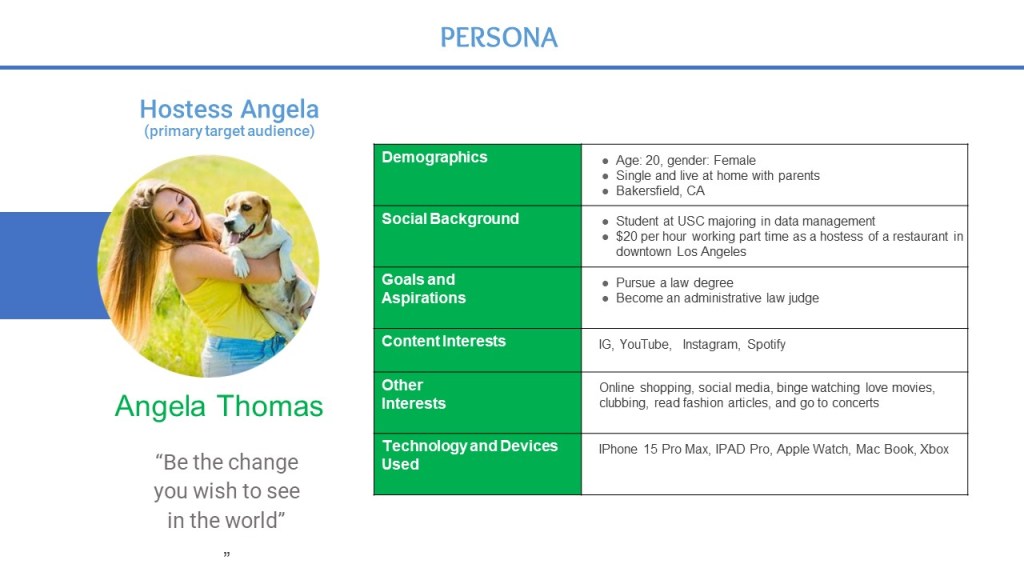
      Through data analysis, customers with shared characteristics can be grouped, a process known as segmentation. I assigned names and constructed customer profiles detailing specifics like ages, job titles, locations, goals, needs, and pain points. These profiles give rise to distinct personas, serving as representations of our ideal customers. An example is provided below.
    An example of persona

    The inclusion of various details about personas depends on the nature of the business. Some enterprises incorporate two or three personas, while others may utilize as many as ten. The quantity is not fixed; it varies based on your objectives, clientele, and products or services. Diverse identities are necessary because one-size-fits-all approaches are ineffective. Marketing strategies must be customized to accommodate individual differences. I even crafted “negative personas,” dubbed “bad apples,” representing those yielding negative ROI and warranting dismissal. In the upcoming blog, I will elaborate on the research process involved in constructing diverse personas.

  • 5) Navigate the Terrain of Customer Data

    While the internet offers a vast option of resources, the challenge lies in pinpointing the most reliable sources of information. My approach merges in-depth customer insights with broader trends to create a well-rounded picture. This involves directly engaging with customers through surveys, interviews, and relationship management to understand their needs firsthand. Collaborating with customer-facing teams unlocks their invaluable experience from daily interactions.

    Graph and chart

    Additionally, research on competitors shed light on customers, while social media analysis, Google trends, and website analytics offer a wider lens into customer behavior and preferences. This combination allows me to craft personas that are not just data-driven, but truly capture the essence of our customers. I also use research websites that provide complimentary data, including the following:

    1. The United States Census Bureau

      Data Tools and Apps – This is a fantastic starting point to dive into the various data types available such as:

      Census Business Builder – Provides businesses with data that can help with opening or growing a business.

      Explore Census Data – Offers demographic data from the latest census report.

      Business Dynamics Statistics Explorer
      Helps you find information about the numbers of businesses in different industries.

    2. The Bureau of Labor Statistics

      Discover valuable insights for your marketing strategy with this website’s data on employment and industry trends. Explore demographics with the Demographic Data Source and analyze industry performance with the Industry Productivity Viewer. These reports offer insights into the labor market and the production levels of various businesses.  Focus on reports and data points that specifically highlight business outputs.

    3. Pew Research Center

      This platform offers research findings derived from surveys designed to grasp people’s perspectives and behaviors across a broad spectrum of topics, including values, politics, religion, and current events. Additionally, it offers a more global perspective on data compared to the two preceding websites.

      Staying ahead of the curve isn’t just about chasing trends. Marketers, regardless of B2B or B2C focus, should be proactive in exploring available data to refine targeting strategies. The wealth of resources, like the demographic data sources mentioned earlier, empowers us to gain a deeper understanding of our customers.

      However, the key lies in strategically selecting the most relevant resources to achieve specific business goals. By embracing a data-driven approach, marketers can make informed decisions and optimize their campaigns for maximum impact.
  • 6) Turn Browsers into Buyers: Lead Nurturing Advantage

    Lead generation, a key part of inbound marketing, involves attracting potential customers and capturing their contact details (most commonly through forms), with the goal of nurturing their interest and converting them into customers. These leads, once qualified by marketers (also known as Marketing Qualified leads) as having a likelihood of making a purchase, are then passed to the sales team for further engagement and hopefully, a closed deal.

    1. Supercharge Your Sales Pipeline

      Offering useful content through multi-channels using targeting strategies is an effective lead nurturing technique. Acquiring as much information as possible from the leads and designing custom content to nurture them proves to be effective. Leverage a combination of channels such as emails, social media, infographics, blogs, white paper, websites, retargeting and follow-up by the sales team. Deliver personalized content according to the stages of the sales pipeline.

      Lead nurturing requires collaboration with the sales team. For instance, during my time as a marketer, I would regularly communicate my nurturing strategies to them, seeking their input. Given their frequent interactions with prospects and customers, they possess valuable insights. Working closely with the sales team is essential for success.
    2. Elevate your Brand

      Enhancing brand reputation plays a pivotal role in cultivating leads. During my tenure at a bank, I initiated a focus group aimed at uncovering the factors influencing individuals’ choice of banking institutions. One resounding determinant emerged: the brand itself. Subsequently, I devised a multifaceted approach to fortify our brand identity, positioning us as not only a provider of financial products and services but also as a beacon of financial literacy and security against scams.

      This initiative evolved into a comprehensive brand-building strategy that transcended product promotion. We endeavored to establish ourselves as a dependable financial ally, actively engaging in the dissemination of financial education and anti-scam measures. As our institution flourished, we recognized the significance of nurturing this reputation, acknowledging its pivotal role in engendering trust and empowering prospective clients.
    3. Assign Scores to Leads

      In the realm of sales and marketing, not every customer is the same. This also holds true for leads—they exhibit a range of behaviors and levels of interaction. Lead scoring comes into play by assigning points to leads and distinguishing them based on their actions.

      Visualize a continuum: at one extreme are hot leads, actively engaged and on the verge of making a purchase decision. At the opposite end lie cold leads, perhaps only filling out a contact form without displaying further interest. It’s essential to collaborate closely with the sales team to determine which actions warrant higher scoring.

      This scoring mechanism aids in prioritizing leads—those with higher scores are primed for a handoff to the sales team, whereas those with lower scores may benefit from additional marketing efforts before reaching the sales-qualified stage.

      Traditionally, our approach leaned heavily on outbound marketing, a unilateral strategy primarily aimed at driving sales. It revolved around promotions and sales pitches, often involving expensive printed materials sent to numerous households, which incurred substantial costs. Any errors in these materials necessitated costly reprints. Fortunately, today we have the advantage of tapping into various digital platforms to foster connections. To thrive, businesses must prioritize cultivating mutual relationships with their audience. Central to this is employing lead nurturing strategies that prioritize attentive listening and responsive engagement, fostering a dynamic two-way communication process.